Autism and ADHD can show up together more often than many parents realize, and the combination has a name: AuDHD. Here’s what it means, what it can look like in young children, and how to know when it’s a good time to reach out for support.

You may have read about autism. You may have also read about attention-deficit/hyperactivity disorder (ADHD). And you might find that somehow your child seems to fit pieces of both, plus a few things that don’t quite fit either one. If that’s your case, there’s a good chance you’re describing something real, and it has a name.
AuDHD is a term for having both autism and ADHD. It describes what it’s like to live with signs of both conditions, which can mix together in tricky ways. It’s a simple way to talk about this experience, not an official medical diagnosis. A doctor won’t write “AuDHD” on a chart. Instead, a child would be formally diagnosed with both autism spectrum disorder (the clinical name for autism) and ADHD. The term itself was created by autism advocates to describe what it’s like to live with symptoms of both conditions, since the symptoms can interact in ways that are confusing to sort out.
Having both is far more common than most parents expect. About 39% of autistic people also have ADHD, according to a review of more than 50 studies published in 2021, although most people with ADHD do not also have autism. It wasn’t until 2013 that having both conditions at once was officially recognized in the Diagnostic and Statistical Manual of Mental Disorders, Fifth Edition, the guide healthcare providers use to diagnose and study mental health conditions. Because the combination is still a newer area of study, there’s less research on how AuDHD specifically affects people, compared to research on autism or ADHD on their own.
Autism and ADHD are both neurodevelopmental conditions, meaning they shape how a child’s brain develops from an early age. Both conditions involve challenges with attention, social interaction, and managing emotions, so it makes sense that having both at once can make those challenges more intense.
A few examples of how the overlap can show up:
Attention. Kids with ADHD often struggle to focus on a task or activity because their attention naturally drifts. Kids with autism tend to focus intensely on their own interests and have a harder time shifting their attention to something else. A child with both may be unable to focus on things that don’t interest them while also struggling to shift away from the things that do.
Social interaction. Kids with autism often have trouble reading nonverbal cues and following the natural back-and-forth of a conversation. Kids with ADHD can struggle socially too but usually because they’re impulsive, interrupt often, or have trouble paying attention or waiting their turn. A child with both may have trouble sensing how others are feeling in the moment and trouble holding back the urge to interrupt once they’re already talking with someone.
Big emotions. Kids with autism can melt down when they’re overwhelmed by sensory input, a sudden change, or social confusion, often without realizing their emotions were building up. Kids with ADHD tend to go from calm to a big reaction very quickly, often out of frustration or impulsivity. Put together, this can look like frequent, intense emotional moments with more than one cause mixed in.
Here’s the part that can be confusing for parents and caregivers: Sometimes autism and ADHD don’t just add up. They pull in opposite directions. Autistic children are often more comfortable with a predictable routine, while children with ADHD may be impulsive and drawn to new experiences and change. A child with both may want a consistent routine and act impulsively within it, or want their room organized in a very particular way while genuinely struggling with the executive function skills needed to make that happen.
This tug-of-war can also show up socially. A child with both conditions might act on impulse in a social moment and then spend a long time afterward replaying it and wondering if they did something wrong. None of this means your child is being difficult on purpose. It means two different sets of wiring are sometimes asking for opposite things at the same time.
In very young children, autism and ADHD can look really similar on the surface, which is part of why AuDHD can be tricky to spot early on. Common overlapping behaviors in toddlers and preschoolers include big tantrums, high energy, trouble following directions, and speech that’s a little behind schedule.
That overlap can make it hard to tell whether a behavior comes from autism, ADHD, or both. Here are a few patterns that tend to point toward one condition or the other. If you see signs from both conditions, it might be worth asking about both, though every child is different.
Attention. ADHD-related attention can look different depending on the type. The hyperactive-impulsive type often looks like constant movement, climbing, and a hard time settling into any one activity. The inattentive type often looks like a wandering focus and trouble finishing tasks, unless the activity is something your child finds especially interesting. In that case, they may lock in with intense focus, which can look a lot like autism-leaning attention. Autism-leaning attention often includes an intense, narrow focus on a specific toy or topic and a hard time being pulled away from it.
Social play. ADHD-leaning behavior, especially the hyperactive-impulsive type, often includes wanting to play with others but jumping in impulsively or having trouble taking turns. Autism-leaning behavior often includes limited pretend play, playing the same way repeatedly, or preferring to play alongside others rather than with them.
Routines and change. ADHD-leaning behavior often includes seeking out new and different things. Autism-leaning behavior often includes a strong need for sameness and real distress when a routine changes.
Autism and ADHD are usually diagnosed at different ages. Here’s a general guide to when each one can be diagnosed and when diagnosis most often happens.
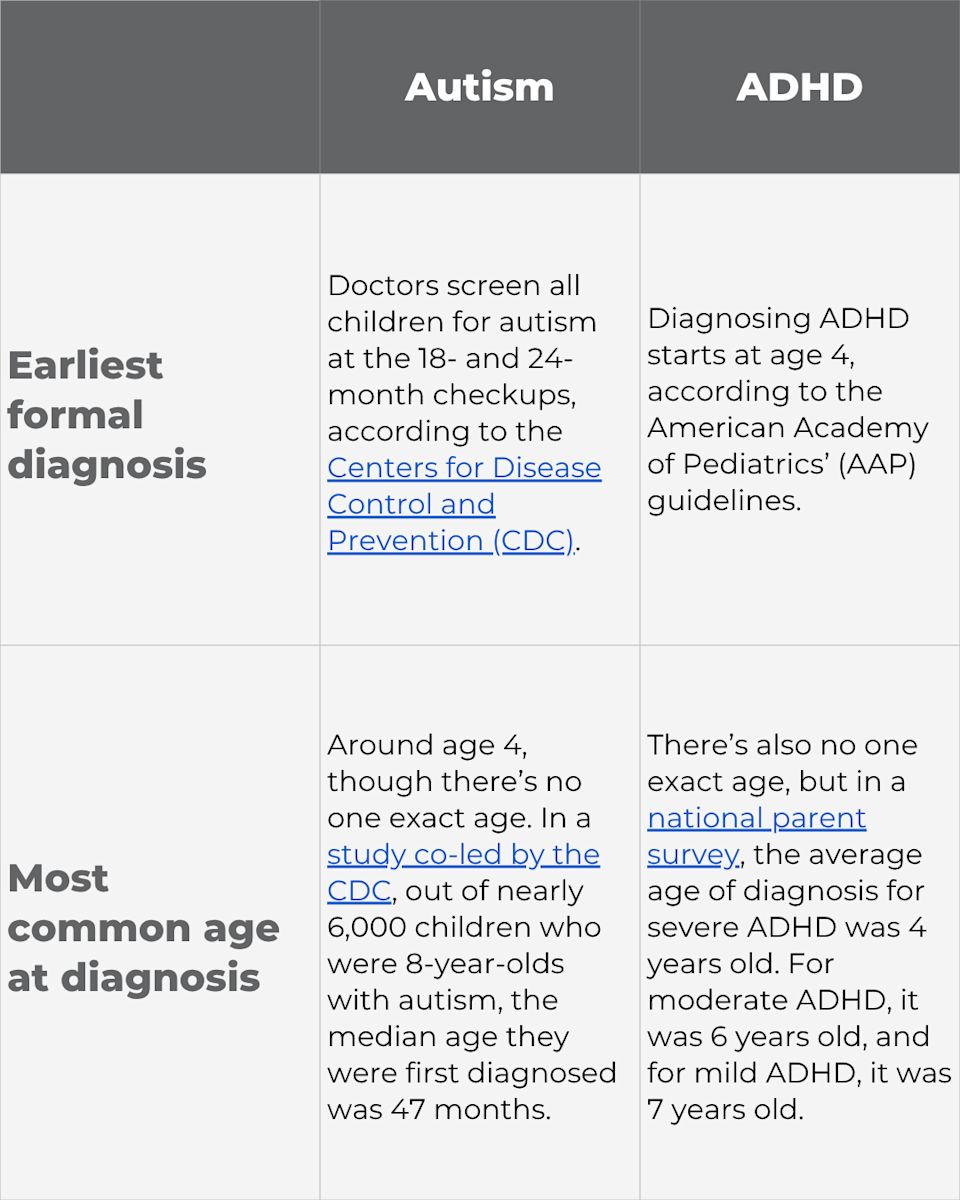
These ages are averages, and some children are diagnosed earlier or later.
Why doctors often wait to diagnose ADHD. Most toddlers are busy, easily distracted, and quick to move from one thing to the next, so these things alone don’t point to ADHD. To diagnose it, doctors look for signs that last at least six months, show up in more than one place (like home and child care), and go beyond what’s normal for a child’s age. That often becomes clearer around the time a child has to sit still in class, learn letters, or stay quiet during story time.
What to expect at age 5 or younger. A very active 2-year-old doesn’t necessarily have ADHD, and medication isn’t typically part of the picture for toddlers, since ADHD guidelines begin at age 4. Even for children ages 4–5, AAP recommends starting with parent training in behavior management, then considering medication if that doesn’t help enough.
What you can do now. Notice how your child plays, listens, and settles, and share what you see at checkups. You might say, “My child has a hard time settling down. Can we keep an eye on it together?”
Autism is different. Signs of autism can show up earlier, so there’s no need to wait on those concerns. If something about how your toddler communicates, plays, or connects with others feels off to you, mention it to your pediatrician anytime.
You don’t need to have it all figured out. If your child’s attention, social play, emotional reactions, or need for routine feels like more than everyday toddler or preschooler behavior, it’s a good time to talk to your pediatrician.
A few things worth knowing as you think about next steps:
Getting one diagnosis doesn’t rule out another. It’s fairly common for a preschooler who is autistic to first be diagnosed with ADHD, with an autism diagnosis coming years later. A study mentioned in a Child Mind Institute article found that children who were diagnosed with ADHD first received their autism diagnosis nearly three years later, on average, than children with autism alone. If your child already has an ADHD diagnosis or a sensory processing note in their chart, it’s still worth asking your pediatrician whether autism should be considered too, especially if things aren’t improving with the current plan.
Early evaluation matters. Children with autism tend to benefit the most from social skills support when they receive it in toddlerhood, so a delayed diagnosis can mean missing out on the most helpful early intervention.
You can ask for a second look. If your child’s current treatment plan doesn’t seem to be helping as much as you expected, it’s okay to ask your provider if there’s more going on besides the current diagnosis.
A specialist can help sort it out. A developmental pediatrician, child psychologist, or healthcare or mental health professional experienced in both autism and ADHD can offer a more thorough evaluation than a single well-child visit typically allows.
There’s no blame here. Autism and ADHD are both neurodevelopmental conditions your child was born with. Nothing you did caused either one, and nothing you did caused them to occur together.
Every child with AuDHD is different. Because the traits of autism and ADHD can combine in so many ways, two children with the same dual diagnosis can look very different from each other. There’s no single “AuDHD profile” to compare your child against.
Treatment usually addresses both. Children with AuDHD often benefit from a combination of supports, such as behavioral therapy, social skills training, occupational therapy, and sometimes medication, tailored to both sets of needs rather than just one.
You know your child best. If something feels off to you, even if a provider hasn’t flagged it, it’s okay to keep asking questions and requesting a more thorough evaluation. Trusting your own observations is part of getting your child the right support.
Whatever an evaluation shows, understanding how autism and ADHD can show up together is a good first step toward getting them the support they need.