Watching your child learn to talk is one of the most amazing parts of being a parent. From that first cry that makes your heart race to the moment they clearly say “mama” or “dada,” every sound and gesture is special because you're seeing something incredible—your little one learning to share their thoughts, needs, and personality with the world.
Understanding what to expect at each stage can help you support your child's talking skills, celebrate their progress, and know when it might be helpful to seek extra support.
During your baby's first year, something amazing is happening inside their growing mind. Their brain is quickly building the foundation for all future talking, making millions of connections that will help them learn language for years to come. It might look like your baby is just lying there or playing, but they're actually working very hard. Inside their amazing little brain, they're learning to control their body, recognizing the special sounds of your family's language and forming the emotional bonds that make talking meaningful.
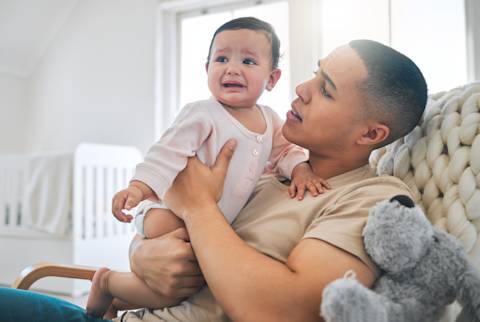
Those early coos, gurgles, and even cries? They're all part of your baby's way of talking, and they're trying to “talk” with you from day one.
Here's something that might surprise you: Your baby understands much more than they can tell you. By 8 months, they know their own name and familiar words like “mama” and “dada.” They also understand simple requests like “come here” when you gesture to them. This understanding develops long before they can actually speak.
Your baby is also working on showing their feelings. They start with natural sounds and crying, but by 6–8 months, you'll hear those adorable babbling sounds, like “ba-ba-ba” or “ma-ma-ma,” as they practice the building blocks of speech.
Talk about your day together: “Now we're changing your diaper. Let's put on this clean diaper.” It might feel silly at first, but talking all day long is like giving your baby language lessons.
Respond to every try: When your baby cries, coos, or makes gestures, respond as if they're having a real conversation with you. Because they are!
Read together daily: Even newborns benefit from hearing the rhythm and patterns of language through books.
Make eye contact: This helps your baby understand that talking is a two-way street.
Copy their sounds: When they babble, babble back. You're showing them how conversations work.
The toddler years are when language growth becomes truly exciting, and sometimes, overwhelming! Your child's brain is making millions of new connections, and suddenly they realize that words have power. This is when you'll hear their first clear words, watch their vocabulary grow fast, and see their personality really start to shine through their talking.
Between 12 and 18 months, most children say their first real words. By 18 months, they typically have 20–50 words and start putting them together, like “more milk” or “daddy gone.” Don't worry if your child seems to understand everything but isn't saying much yet; this is completely normal.
By age 3, most children have vocabularies of several hundred words and can form 3- to 4-word sentences. They become little storytellers, asking endless “why?” questions and learning to express their big feelings with words instead of just actions.
Add to what they say: If they say “car,” respond with “Yes, that's a big red car!”
Give them choices: “Do you want milk or water?” This encourages them to tell you what they want.
Be patient with responses: Give your child time to think about what you've said and come up with their answer. Count to 10 in your mind slowly if you need to.
Read fun books: Books with flaps, textures, or simple questions keep toddlers interested and learning.
Answer those endless questions: Their constant “why?” questions are actually how they learn about the world. They mean their brain is working beautifully! Try to stay patient.

If your family speaks more than one language, you're giving your child an incredible gift. Research shows that children who learn two languages reach the same talking goals as children who learn one language—you just need to count words from both languages together.
For example, an 18-month-old Spanish-English child might have 15 Spanish words and 10 English words for a total vocabulary of 25 words—right on track! Don't worry if your child mixes languages; this shows they understand that they know two different language systems.
Use the languages you're most comfortable with.
Read books in both languages.
Connect with other families who share your languages.
Be consistent about when and where each language is used.
Every child's language journey is unique, and that's perfectly normal. Some children are naturally chatty, while others are thoughtful watchers who prefer to listen before they speak. Birth order, personality, and learning style all play a role in how quickly children develop language skills.
However, there are times when delays may mean your child needs extra support. Trust your gut feelings. You know your child best.
By 12 months:
Doesn't respond to their name
Doesn't use gestures like waving or pointing
Doesn't babble with different sounds
Has lost skills they once had
By 18 months:
Doesn't say at least 10–20 words
Doesn't follow simple directions like “get your shoes”
Doesn't point to show you things
By 24 months:
Knows fewer than 50 words
Doesn't put two words together
Can't follow two-step directions, like “Get your shoes and bring them here” or “Pick up the toy and put it in the box”
By 36 months:
Strangers can't understand most of what they say
Doesn't use 3- to 4-word sentences
Doesn't ask questions
If your child does need extra help with language growth, know that getting support is a sign of good parenting, not failure. Getting help early can make a huge difference, and many children who receive speech support go on to be excellent communicators.
Keep in mind, needing extra support doesn't determine your child's future. It just means they might take a different path to get there. Speech therapists can give you strategies that build on your child's unique strengths.
Here's the most important thing to remember: Your love, patience, and involvement in your child's talking journey matter more than any milestone chart. Every child grows at their own pace, and your encouragement and involvement are the most powerful factors in their success.
If you ever feel worried about your child's growth, don't hesitate to talk with your pediatrician. Getting help early can prevent challenges with behavior, learning, and social relationships later on. You're not overreacting. You're being a thoughtful, caring parent.
Continue to celebrate every small step forward, whether your child is an early talker or needs more time to find their voice. That first word, that first sentence, that first conversation—those moments are coming, and they'll be perfect because they're uniquely your child's.